

gehringer_2
-
Posts
26,944 -
Joined
-
Last visited
-
Days Won
201
Content Type
Profiles
Forums
Events
Blogs
Store
Articles
Everything posted by gehringer_2
-
I could something like this: Skubal, Olson, Flaherty(or equv FA), Holton with number 5 coming from however it shakes out in ST - one of Manning, Mize, Gipson-Long, Montero, Hanifee, Hurter, Madden, Maeda, though if Hurter make the rotation Holton stays in the pen. Sign a LH reliever to if Holton goes to the pen. A second LH starter would be a good thing to have against Cleveland, though Minny and KC are not particularly LH as Cle is.
-

Trading For a Defensive End/Edge Rusher
gehringer_2 replied to Mr.TaterSalad's topic in Detroit Lions
Agree. Doesn't seem his MO, but maybe he's never been in this position. The alternative is pick up depth and do a lot of rotation to keep guys fresh. -
Week Seven: Detroit Lions (4-1) @ Minnesota Vikings (5-0)
gehringer_2 replied to MichiganCardinal's topic in Detroit Lions
Absolutely. For football, pick up your in-progress recording at about half-time and finish the game just about at the real time point. For baseball somewhere around the 3rd inning. The programmers will eventually fight back with more live game insertion ads, but by then maybe we'll have AI video processing to chop them back out. -
Michigan Football 2024 aka The Year Michigan has to Defend a Natty
gehringer_2 replied to romad1's topic in College Sports
Again, lack off effort, institutional pull-back, incompetence? The size and options of the grad programs at Ann Arbor have been a point of leverage for bringing in graduate O linemen with remaining eligibility. And that's even the kind of thing that is largely coach or NIL dependent, these are guys who know they are not going to be playing on Sunday - they are actually there to get their degrees, but know that at 24/5 they can get their tuition paid and still play a little winning FB against 21/22 yr olds. -
He's a little undersized for as hard as he throws, I don't know what the prevailing theories are on that anymore. Looking at his record he's made 21, 25, 28, and 22 starts over the last 4 yrs. He's a regular Cal Ripken compared to Mize or Manning!
-
I think you forgot the teal there.
-
yes it is, yet of the three teams alive at the start of the day, the Yankees have the smallest payroll.
-
One thing I can say, in my lifetime, and probably never in the history of the republic, has an ex-president thrown himself into a presidential campaign the way Obama has for Harris. He waited to the end to do it, but no question he's all in now.
-
Week Seven: Detroit Lions (4-1) @ Minnesota Vikings (5-0)
gehringer_2 replied to MichiganCardinal's topic in Detroit Lions
Beating the Vikes on the road should improve the Lions perceived bargaining leverage if they are pursuing a DE. -
Michigan Football 2024 aka The Year Michigan has to Defend a Natty
gehringer_2 replied to romad1's topic in College Sports
That's fair to a degree, but the counterpoint is that even if JJ had re-upped that's not adequate excuse to be that thin behind him. The portal has certainly upset a lot of conventional recruiting SOP, but in a top college program you still have to keep a pipeline stocked at the most critical position on the field. We all saw enough of Orji last season to be underwhelmed. -
Yup. Because there is currently no survey/sampling method available in the US that give a reasonable certainty of obtaining a random sample, pollsters have to make adjustments to their survey results to fit what they think they already 'know' about the population from past experience. However if there is change in the population with respect to those assumptions, the process of correlating the sample to the state of the population in the past guarantees that change actually seen will be assigned as sampling error and go undiagnosed. They can do a lot of massaging but in the end you can't completely correlate your way around this problem. In an environment were random sampling ranges from difficult to impossible, political polling is likely to work well as long as society is basically stable, but accuracy will be more a matter of luck if there are movements upsetting the established political alignments, which you only find out is true or not after the election. The working assumption since at least 2016 is that the distribution of political opinion across varies markers in the population is tightly fixed. If that remains true, the polls will be accurate - at least those taken by honest pollsters. But if you suspect old assumptions may be breaking down, you won't be surprised to see the polls miss things by more then their supposed margins of error.
-
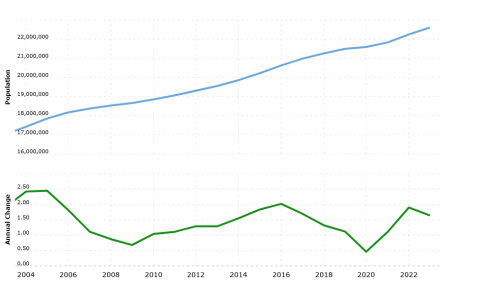
Not clear that many more people than normal went to FLA immediately post COVID. Population growth has been pretty steady. There was some variance around COVID - it appears COVID kept kept some people in place that would have moved and then did move when things got back to 'normal', but it would be hard to argue overall movement into FLA was out of the ordinary in more than a minor way compared to pre-covid levels. the number one state that people leave to go to FLA is apparently NY. That's probably true most years. The interesting question is whether the middle boomer retirees going to FLA now are any more or less red than the early and pre-boomer retirees already there. My experience as a middle boomer would be that our older sibs were more conservative than we were, but that's one anecdotal take. Also interesting that half a million fewer votes were cast in the governor's race in 22 compared to 18 and DeSantis pickup up another half million. Crist certainly underperformed. https://www.macrotrends.net/global-metrics/states/florida/population

-
We did a park trip a couple of years ago and at Arches, we watched - and then participated in a completely self organized system where each person or couple set up their camera - handed it to the next person in line, took their pose in the arch, got their shot and so on it went for as long as we were there. Humans can do OK, once in a while.
-
meh - he buying signatures, not votes. If the Democratic voters of PA are on their game, they'll provide lots of signatures and scam the scammer. Sure it's a pain to be on one more mailing list, but winning Musk's money and then giving to the other side would be worth it.
-
Michigan Football 2024 aka The Year Michigan has to Defend a Natty
gehringer_2 replied to romad1's topic in College Sports
I really don't know - I've said before I think they have a longer term perspective than the fan base and are happy to tread water - at least for a while - waiting to see where the future shakes out and being frugal until they see where inivestment give them the best shot at longer term success - but that's a pretty subliminal impression, they may just be incompetent. . the afterglow of the NC meant that income for this year was assured so I don't see where real pressure comes from at least till next season. -
Act Blue is the general Dem fundraising site. Pelosi runs the Congressional campaign office. If you have a particular congressional race in mind, go straight to the candidate's website.
-
Yeah - Montero looks like a guy who needs perfect command to be successful. I suppose anyone could turn into the next Greg Maddux, but possible doesn't mean likely.
-
2024 - 2025 Detroit Tigers Offseason
gehringer_2 replied to AlaskanTigersFan's topic in Detroit Tigers
That's a generalization that's overbroad. As noted, curation can have value to the end consumer and there is no reason a priori for a curator not to be paid for their service if their customers see a value in it. If anything, the volume of data the internet spews makes well done curation a more valuable service than ever. -
Michigan Football 2024 aka The Year Michigan has to Defend a Natty
gehringer_2 replied to romad1's topic in College Sports
He asked the question, that is the essence of the answer, it’s no more or less than that. If you want a kinder gloss, you can say Harbaugh hamstrung his own recruiting by so publicly and constantly courting the NFL, same difference as far as the current team goes. I’m fine with the NC, I just don’t really care about it. Doesn’t make the sky in Ann Arbor any bluer. if I like a movie, I don’t care if it wins an Oscar. If a team was entertaining in a given season, they get as far as they get. It’s entertainment, the value ends there. ‘OK’ or not doesn’t really parse as a question. -
What's curious is why the Dems are not releasing any. Obviously the Blue side has not stopped polling. I know they figure fundraising to hold up better if there is a requisite amount of panic out there, but it still seems to me that at some point you can over do that - you need a little good news too if you have it.
-
Michigan Football 2024 aka The Year Michigan has to Defend a Natty
gehringer_2 replied to romad1's topic in College Sports
Because Harbaugh knew he was bailing and that win or lose, JJ was his last shot to win at UM. In Jim's world there was no tomorrow in Ann Arbor after JJ, so no need to have another QB ready. -
I will grant that if the same poll using the same methodology shows movement over time it's significant, but I'm a bit skeptical what we are seeing recently meets that standard.
-
I was glad to hear what Harris said about Torkelson needing to work on handling 'shapes' which I guess is 21st century GM argot for pitch recognition, as opposed to what Hinch usually said about Tork in earlier days, which was that he needed to 'hit good pitches.' If Harris has shifted the objective for Tork away from selectivity (which I think Tork was over doing) toward hitting what the pitcher throws in the zone, that is a direction where I think progress is possible.
-
we don't know if they are going to operate on an innings cap and if so how hard it will be. If they are willing to let him go to 150 they can pretty much start him regularly but cap his outings at 5 IP - maybe 75-80 pitches. Last off-season they had talked about limiting Skubal but in the end let him go over 200 IP so I doubt any plans made in April aren't going to be adjustable as the season progresses. OTOH they will/should/must(!) be more careful with Jobe than they were with Skubal, given the difference in their age/career workload.
-
Lack of appropriate inhibition can be funny in a comedy club, unfortunately in a Presidential candidate it's a symptom of the breakdown of supervisory intellectual capacity.